Saudi Arabia isn’t a destination that’s been shaped by decades of tourism yet.
And that context is important.
The country only introduced a tourist visa for leisure travellers in late 2019. Before that, most visitors could only enter for work, business, family, or religious pilgrimage. Then COVID hit soon after. So realistically, independent tourism has only really been building momentum over the last few years.
That doesn’t make Saudi “behind” — it just means it’s very early in its story as a tourism destination.
I spent one week in Jeddah and one week in Riyadh as a solo female traveller, moving slowly, paying attention to how each city felt to live in day-to-day. Here’s my honest experience, and which one I’d recommend visiting first!
First impressions: two cities, two very different rhythms
Jeddah felt much more residential to me – though I think that was strongly shaped by where I stayed. My accommodation was in a quiet neighbourhood rather than near the historic old town. The nearest cafe was about a 15-minute walk away, and often there weren’t sidewalks, so I’d end up walking on the road. The streets were usually quiet enough that it felt manageable, but between the heat and wearing long clothing out of modesty, even small outings took more effort than I expected.
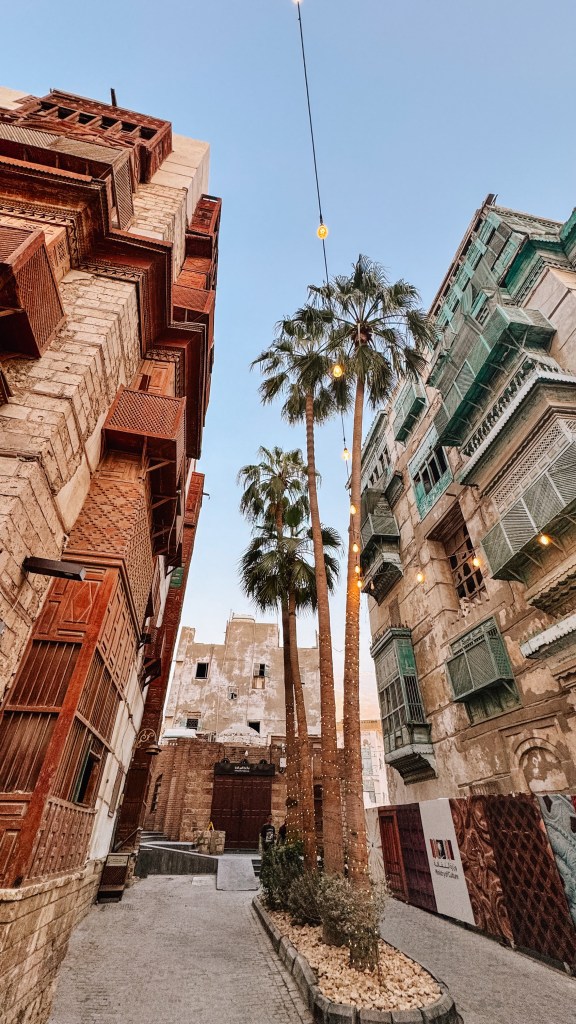
I wouldn’t personally want to stay in Al Balad (the old town) for a full week, which is why I chose to visit it just for the day – and that day ended up being my absolute highlight of Jeddah.
Riyadh, by contrast, felt easier almost immediately.
I stayed in a women’s hostel, which gave the experience a homely, grounded, almost family-like atmosphere. The location was better too: cafes were closer, daily errands felt more accessible, and while some walks still involved busy roads (not ideal), it felt less effortful to simply exist there day to day.
That difference – accommodation and neighbourhood – shaped almost everything.
What there is actually to do (and why Riyadh worked better for me)
One of the biggest contrasts between the two cities was the availability of experiences.
In Riyadh, I genuinely felt like there was structure beginning to form for visitors. I did:
– A guided tour of Al Masmak Fortress
– Exploring Souq Al Zal
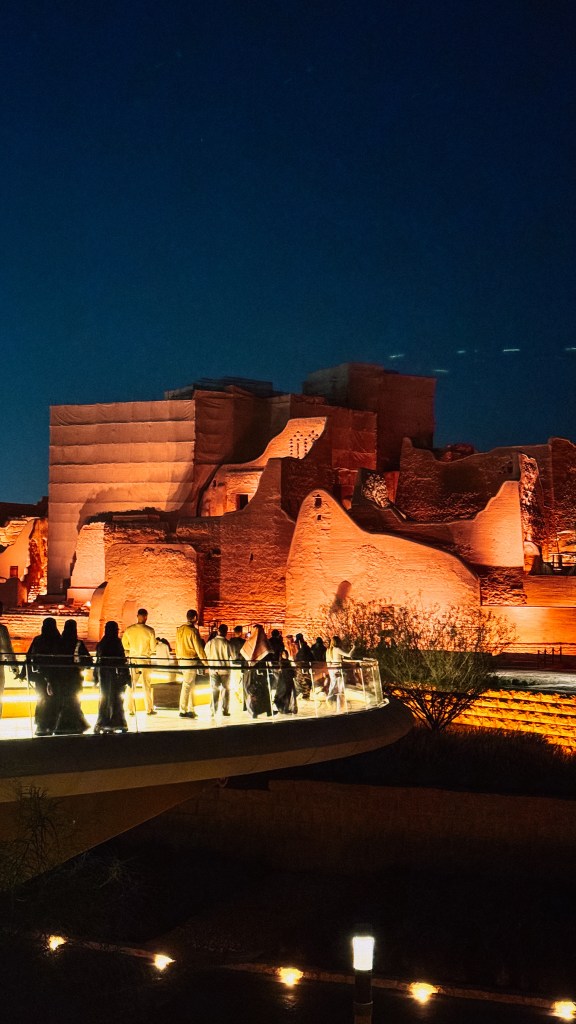
– The historic Diriyah by night
– The National Museum
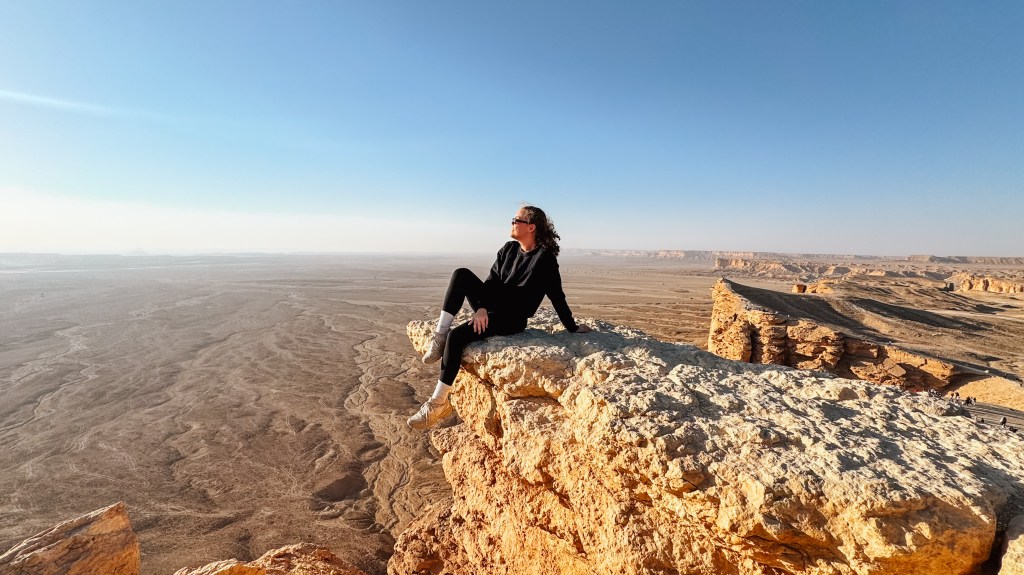
– The iconic Edge of the World day trip
– And used the metro, which was genuinely fantastic (paired with Ubers on either end)
There was variety. History. Culture. A sense that I could fill my days meaningfully.
In Jeddah, my standout experience was absolutely Al Balad, the historic old town. It felt like stepping back in time – textured and layered I did a guided tour there (insanely expensive, but very informative), and my guide was a woman, which opened up such meaningful conversations about life, identity, and recent change in Saudi.
Beyond that, I:
– Saw the famous Jeddah Fountain
– Visited a few malls (including Green Gold Mall)
– Explored where I could on foot
Now – it’s important to say this:
Jeddah absolutely does have more things to do. There are beach clubs, Red Sea snorkelling and diving, resorts, and beautiful oceanfront restaurants.
But for me personally:
– I was coming from Dahab, where I’d experienced world-class diving and coastal life for the whole week prior
– Many of the places I had saved required 40+ minute drives
– And I’m no longer in a phase of travel where I force myself into activities just to fill time
Gone are the days of “I should do this because I’m here.”
If something doesn’t align with how I want to experience a place, I’m okay with letting it go and filling my time differently.
So it wasn’t that Jeddah lacked options.
It’s that fewer of those options aligned with what I wanted to do there.
Walkability, movement, and why this shaped everything
This is where my slow-travel lifestyle really clashed with the reality of both cities.
I connect to places by walking. Wandering. Observing. Sitting in cafes. Letting cities unfold naturally.
Saudi – in its current infrastructure – isn’t built for that.
Even when Google Maps would show a destination as a 40-minute walk, that walk might involve crossing five-lane highways, navigating areas with no sidewalks, or moving through environments designed purely for cars. So often, I’d end up defaulting to Ubers instead – not because I wanted to, but because it felt safer and much more practical.
The result?
I found myself in malls more often than I’d like – not because I love malls, but because they were air-conditioned, walkable, and allowed my body to move.
It wasn’t my natural rhythm. And I felt that deeply.
Culture, conservatism, and being a woman there
This is the part that’s hardest to articulate – but also the most important.
I’ve travelled extensively through Morocco, Egypt, Jordan, Oman, UAE Qatar and Central Asia. I’m not unfamiliar with modesty norms or Islamic cultures.
But Saudi felt… different.
More conservative. More embodied. More intense.
I noticed a lot of staring in both cities – even when I was walking with a local tour guide in Riyadh. At one point he laughed gently and said, “Sorry… people still aren’t used to seeing female tourists here.” And I believe that. It felt more like curiosity than hostility. But it was still very noticeable.
Jeddah felt slightly more socially conservative to me than Riyadh, especially walking through parks late at night where families filled the spaces. I felt very very visible there.
Two encounters stayed with me.
One was with my female tour guide in Jeddah. She spoke openly about the recent changes in women’s rights, but also about the social pressures that remain. Her mother wished she would cover her entire face. She chose not to. She explained that as a tour guide, she wanted to be seen – her expressions, her humanity. She’d studied in Paris and didn’t wear a hijab there. In Saudi, she spoke about modesty less as a personal preference and more as something you simply respect – part of the culture, unquestioned, just how things are done.
The other was a young woman I met at the hostel in Riyadh. She’d grown up there, her family originally Indonesian. She told me she wanted to travel, but her parents wouldn’t allow it. Her small act of independence was booking a weekend stay at the hostel just to meet people and experience something beyond her usual world. She was fascinated by my life and my stories. And I felt both honoured and deeply aware of the privilege I carry.
Personally, I found the modesty expectations challenging in ways I didn’t expect. I wore long pants and long sleeves the entire time (no hijab), and while no one legally forced that on me, the cultural and social expectation of modest dress was very present – informed by Saudi’s Public Decency Law, which encourages covering shoulders and knees and dressing respectfully in public (visitsaudi.com).
I grew up as a woman with no real restrictions on how I could dress – aside from basic social norms – and that freedom shapes how I move through the world. Being in an environment where covering up felt like an unspoken rule didn’t just register intellectually. It registered physically. Emotionally. It stirred questions about autonomy, expression, and identity that I’m still sitting with.
If I had been visiting longer, I probably would’ve purchased an abaya – not because it was legally required, but because I think it would have helped me feel more comfortable and fit in more with the visual language of the places I was moving through. And I absolutely respect that many local women choose to wear their abayas with pride – it’s part of how they express cultural and personal identity here.
Why Saudi feels like a destination still forming
Saudi Arabia feels like a place in the midst of becoming something new.
There’s constant construction. Limited tour options. Infrastructure that doesn’t yet support independent travellers easily. And when options are limited, prices climb – which is especially noticeable when trying to explore beyond major cities.
There are places in Saudi I’d absolutely love to visit – Al-Ula in particular has been on my bucketlist for a long time! But travelling there solo this time felt financially unrealistic. Prices were, honestly insaneeee.
What exists now feels like the beginning of a tourism ecosystem, not the final shape of it. And that’s not a critique – it’s simply the reality of witnessing a destination very early in its opening to the world.
So… Jeddah or Riyadh?
If you asked me right now, honestly?
Riyadh.
It felt more accessible. More structured. More aligned with the kind of experiences I value when arriving somewhere new. It felt like a better introduction to Saudi Arabia at this stage.
Jeddah’s Al Balad was deeply meaningful, and I’m glad I experienced it. But over a longer stay, I personally found it harder to connect with the city in the way I like to travel.
That said – I suspect this answer will change over time. As infrastructure develops, as tourism expands, as accessibility improves, Jeddah especially feels like it could grow into something truly special.
Final thoughts
Saudi challenged me. It stretched me. It unsettled me at times. It also offered moments of connection, perspective, and learning that I’ll carry with me.
Not every destination needs to feel easy to be worthwhile.
There’s something meaningful about witnessing a place this early in its unfolding – before the edges are smoothed, before the experiences are packaged, while the story is still being written.
I’m grateful I got to see this version of Saudi – complexities and all.
– Alexx

 Alex's Adventures