Before you visit the pyramids
Visiting the Pyramids of Giza is one of those experiences that sits high on so many bucket lists – mine included!
They’re ancient, iconic, and deeply symbolic. But they’re also intense, overwhelming, and very different from what most people imagine.
This wasn’t actually my first time visiting. I first saw the pyramids back in 2019, and then returned again six years later when my mum came to visit me while I was in Morocco. We found decent flights for her home to Australia via Cairo and I thought… why not take her to one of the most iconic places on Earth?
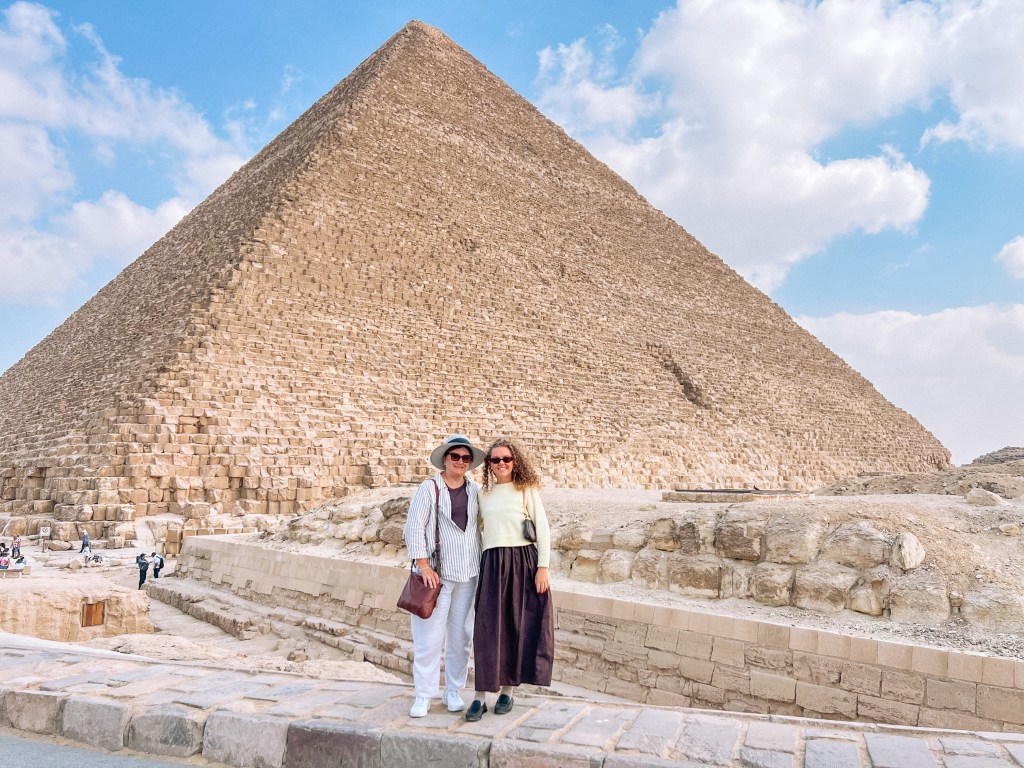
I’m so glad we went.
And I’m even more glad I’d learned a few things since my first visit.
This post isn’t here to romanticise or discourage – it’s here to offer honest, practical insight, and to share my experience, whether you’re planning a visit yourself or simply curious to see the pyramids through my eyes!
The reality vs the expectation
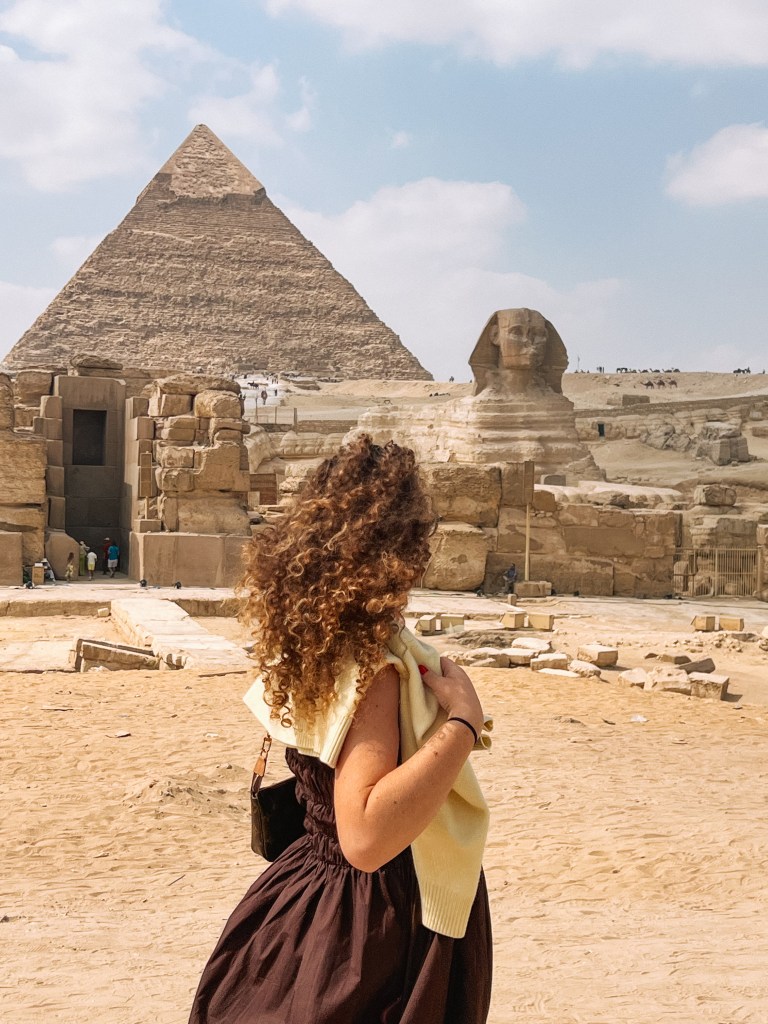
Standing in front of the pyramids is genuinely awe-inspiring. They’re enormous. Timeless. Almost surreal in their scale. No photo truly prepares you for how massive they are in real life.
But the environment around them can be chaotic.
Our morning started with immediate overwhelm. I’d booked an Uber, but quickly realised all the number plates were in Arabic – which meant we couldn’t tell which car was ours. Drivers were stopping, looking at us, beeping. People were approaching. It felt intense straight away.
Then we were dropped at the wrong gate – I’d pinned the older entrance instead of the newer one (oops). It meant getting tickets, entering the complex, and finding the shuttle to Khufu’s wasn’t as straightforward as it could’ve been.
I’d planned for us to start with breakfast at Khufu’s, so I’d organised our guide to meet us there afterward. In hindsight, if it’s your first visit, I’d recommend booking your guide to collect you directly from your accommodation – it would remove a lot of unnecessary stress and make the whole experience feel much smoother.
Everyone was trying to “help” us. Offering directions, rides, photos, services. We decided pretty quickly to keep our heads down and keep walking. Not because anyone means harm – but because the situation can escalate so quickly if you don’t hold boundaries.
This was a very new environment for her, and different again for me this time around too. We were both just trying to stay calm and navigate it together.
Later we learned we should’ve been dropped at the newer gate, which likely would’ve felt calmer and more organised. A small logistical detail – but one that can really shape your first impression.
Why having a guide genuinely helped
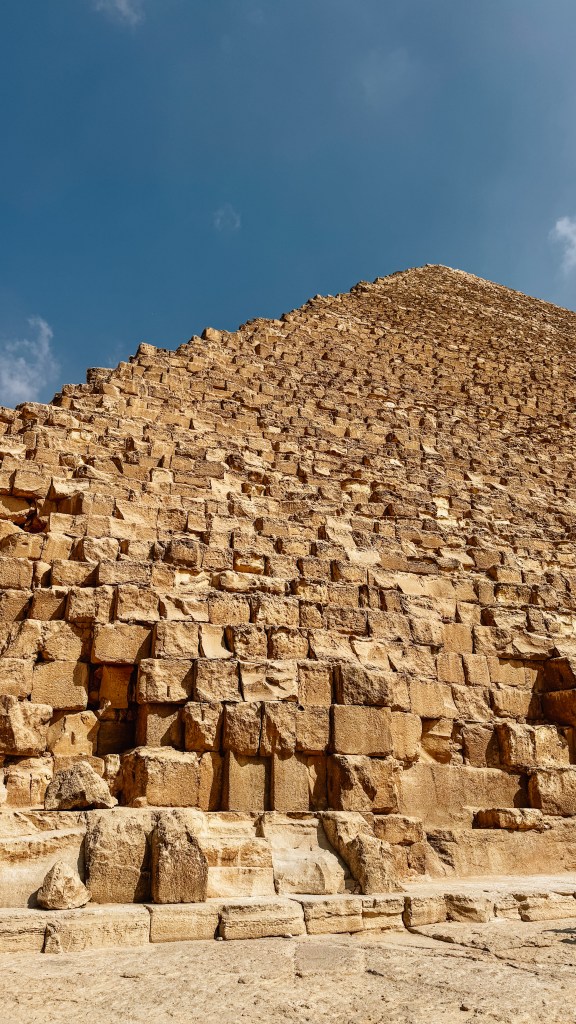
Because we had a breakfast booking at Khufu’s, I organised for our private guide to meet us there afterward. We booked her only a couple of days in advance through ToursByLocals – fairly last minute, but absolutely worth it.
The difference once we were with a guide was immediate.
Not just in terms of ease and navigation, but in how grounded the experience felt. The pyramids aren’t just impressive structures – they’re layered with history, mystery, theory, and unanswered questions. One of the most fascinating parts? Even now, there’s still no complete certainty about exactly how they were built. There are multiple competing theories – from massive external ramps, to hidden internal spirals, to counterweight systems using water – and none have been conclusively proven. The truth is, we’re still piecing it together!
My local friend joked to me that all Egyptians actually know the real answer – it’s just a big family secret passed down through generations. And standing there, staring up at those stones, I get how that mystery lives on.
I’ve added a simple visual just below that shows some of the main theories side by side, because seeing the ideas mapped out makes the mystery feel even more mind-bending.
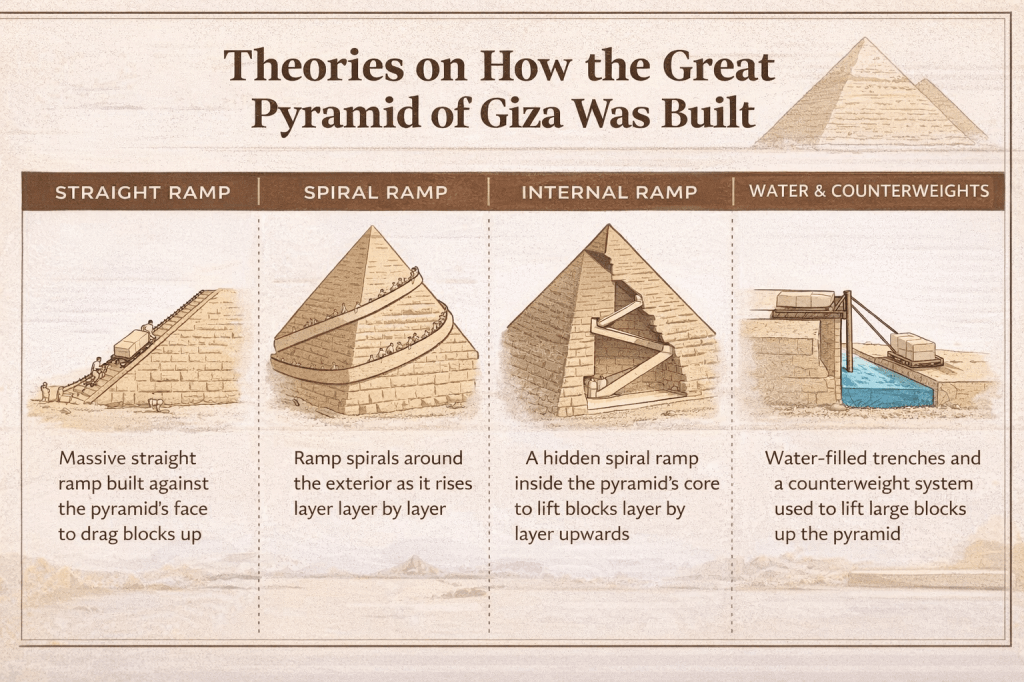
You stand there looking at something so ancient, so precise, so massive – and realise humanity still doesn’t fully understand it. That alone is mind-blowing!
A good guide helps with:
– Navigating the site calmly
– Handling logistics
– Giving cultural and historical context
– Creating space to actually absorb what you’re seeing
– Protecting your energy from constant interruptions
Without a guide, it’s easy to feel like you’re just surviving the environment rather than truly experiencing the place.
The part people don’t warn you about: persistence & boundaries
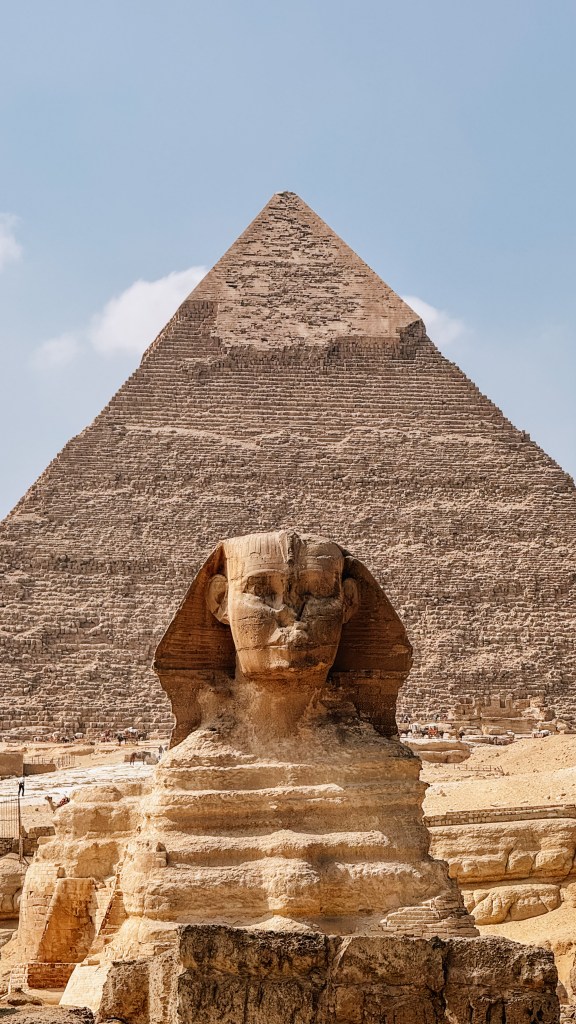
You’ll likely be approached constantly – offers for camel rides, souvenirs, photos, guiding, “help.” It’s not dangerous, but it can be emotionally exhausting if you’re not prepared for it.
I’ve travelled enough now that I’m more comfortable being direct. Saying no firmly. Moving on without guilt. But that took practice.
There’s a balance – you don’t need to be rude, but you also don’t owe anyone your time, energy, or politeness if you feel uncomfortable.
My go-to phrase now?
“La shukran” (no thank you) and keep walking.
For newer travellers, this part can feel quite confronting. You might feel like you’re being mean, or like you’re doing something wrong by setting boundaries. You’re not. It’s a skill – and it gets easier with time.
Khufu’s Restaurant: absolutely worth it
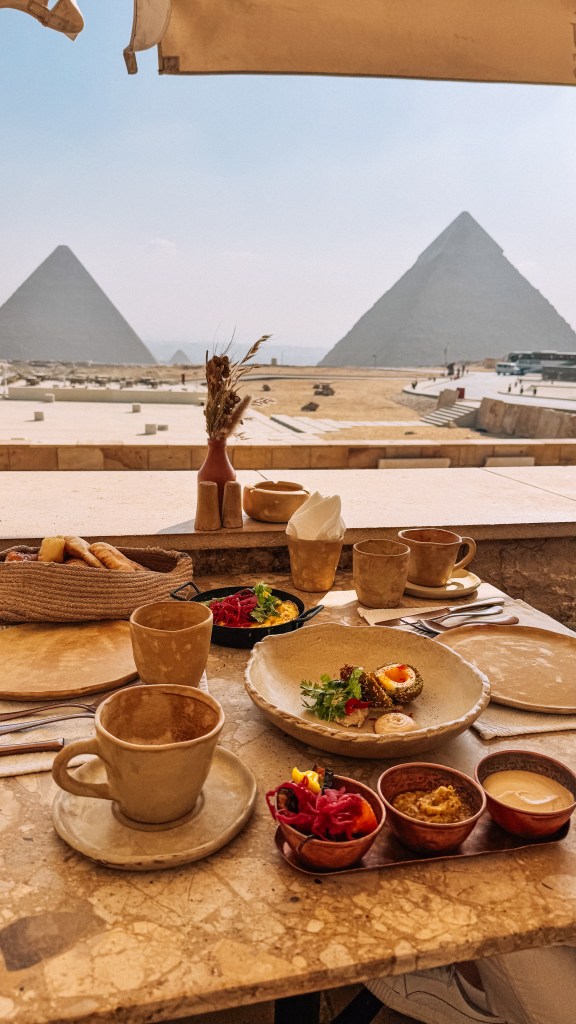
If you’re going to eat anywhere near the pyramids, make it Khufu’s.
It’s not just about the food – it’s about the experience.
Khufu’s wasn’t there when I visited back in 2019, so experiencing it on this second visit felt extra special. Sitting there, with uninterrupted views of the pyramids, away from the noise and intensity outside the gates, felt like a pause button on the day.
We started with coffee (you already know that part was important to me hahah).
Possibly the most iconic morning coffee location of my life. I’m pretty sure I captioned my Instagram story: “My morning coffee location peaked today.” 🤪
We ordered the Falafel Ain Katkoot and Baked eggs glaya. Both delicious. Beautifully presented. Incredible service.
What I appreciated most was the time. Many rushed tours don’t allow you to sit, breathe, and simply take in the view. Being able to linger, reflect, and absorb the magnitude of where we were felt genuinely meaningful.
Ladurée: an unexpected pause
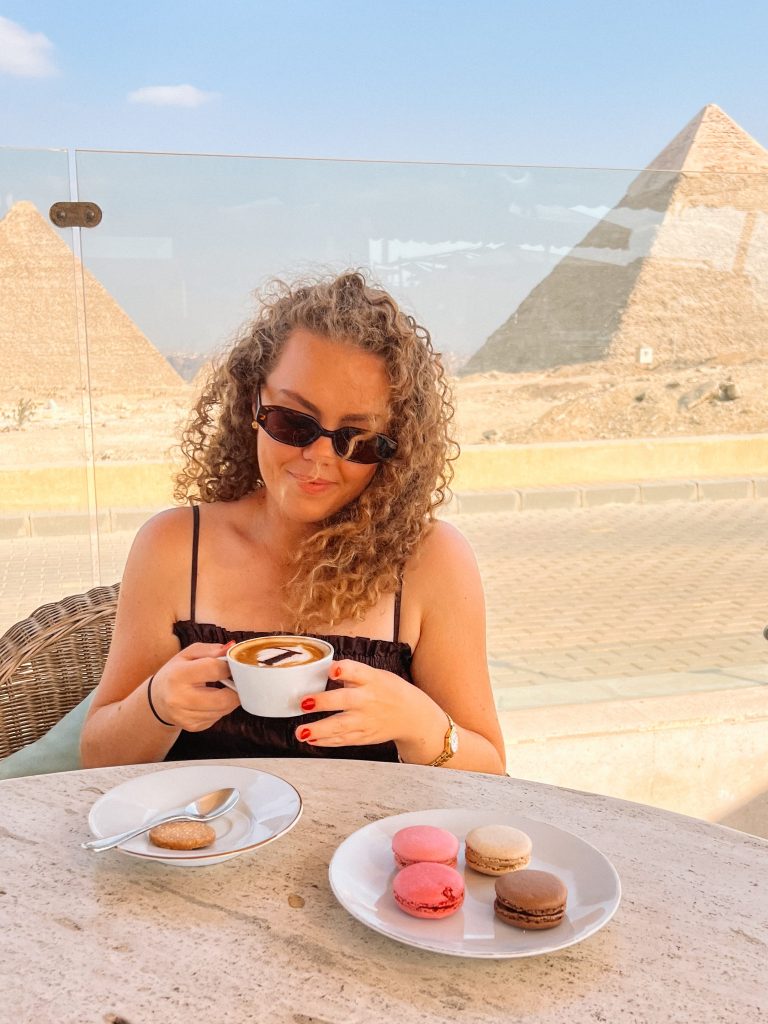
We actually didn’t plan to visit Ladurée at all — we only noticed it while having breakfast at Khufu’s. Later in the afternoon, we went back for coffee and a macaron, and it ended up being another unexpectedly calm pocket within the otherwise intense environment.
It again felt almost surreal: sitting there, vibing out with a coffee and a pastry, while the pyramids sat just beyond the walls.
What did surprise us, though, was what happened afterward. We planned to hop back on the shuttle and revisit another viewpoint for photos – only to be told we couldn’t get off because the complex had effectively closed around 4:30pm.
No warning. No signage we’d seen. Just staff saying it was closed.
So we left.
It wasn’t a disaster, but it was disappointing – and it’s exactly the kind of thing I wish I’d known in advance. If you’re planning your day, it’s worth factoring in that access can end earlier than you might expect, even if you’re still technically inside the site.
Practical things that make a real difference
These aren’t “travel influencer tips” – they’re real, experience-based suggestions:
– Wear closed shoes (it’s extremely dusty)
– Bring water and sun protection
– Do some research beforehand
– Come with questions, not just expectations
– Consider booking a guide
– Understand that overwhelm doesn’t mean you’re doing it wrong
– Be aware the complex may effectively close earlier than expected (we were told around 4:30pm)
– Build your photo plans around the morning/midday rather than late afternoon
– Accept that you may leave with more questions than answers – and that’s part of the beauty
The pyramids are mind-bending. You’re staring at something massive, ancient, and still not fully understood. It’s okay if your brain can’t neatly process it.
Honestly, I think I left with more curiosity than closure — and I actually love that.
The emotional part I didn’t expect
I expected the pyramids to be impressive.
I didn’t expect the emotional complexity of the experience.
There’s something strange about standing in front of structures that have existed for thousands of years, while navigating such a modern, chaotic, commercialised environment around them. It raises questions about history, preservation, power, tourism, access, and what it means to witness something so significant in a world that often feels so noisy.
It wasn’t just a sightseeing moment.
It was layered. Conflicting. Powerful. Reflective.
And I think that’s okay to say – not every iconic place feels purely magical. Sometimes they feel real. Complicated. Human.
If you’re planning to visit
Here’s the honest summary:
The pyramids are so worth seeing.
But they’re not a place to show up blindly.
Go informed.
Go grounded.
Go with boundaries.
And give yourself permission to experience it in your own way – not the curated version you see online.
Continue Planning your Cairo trip:
- → Where to Stay in Cairo: The Best Areas for Every Type of Traveller
- → The Best Cafes in Zamalek, Cairo (My Favourite Coffee Shops)
– Alexx

 Alex's Adventures